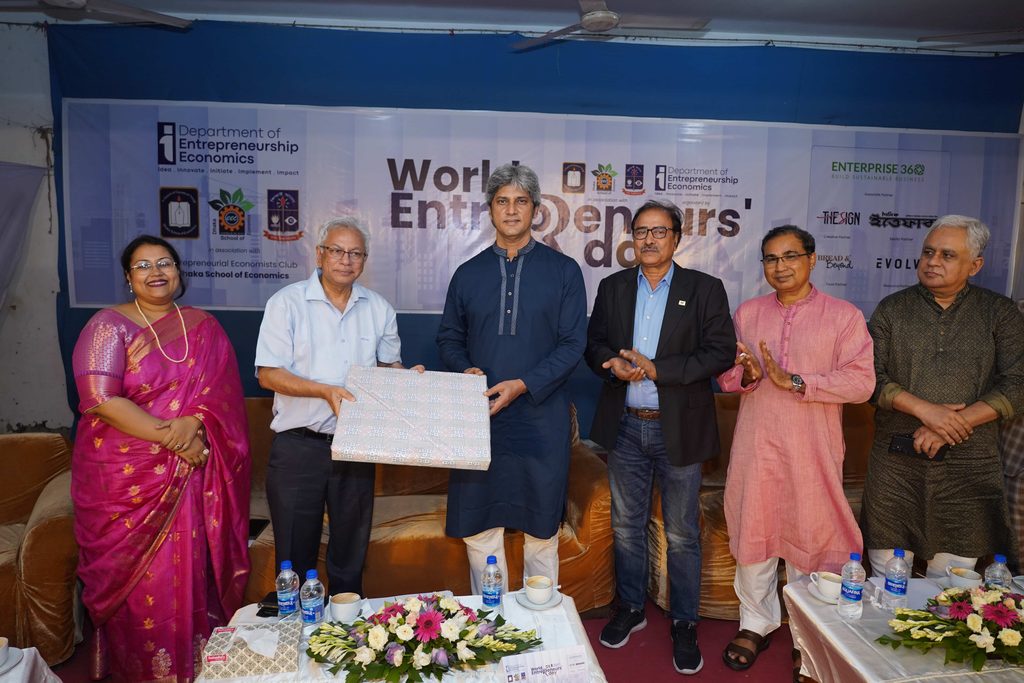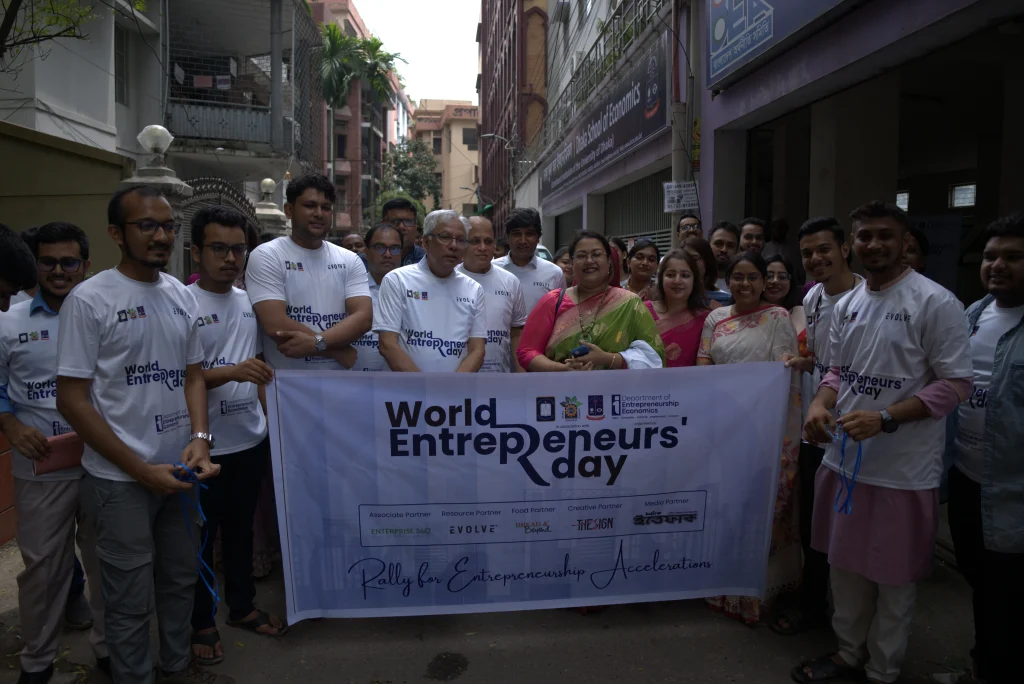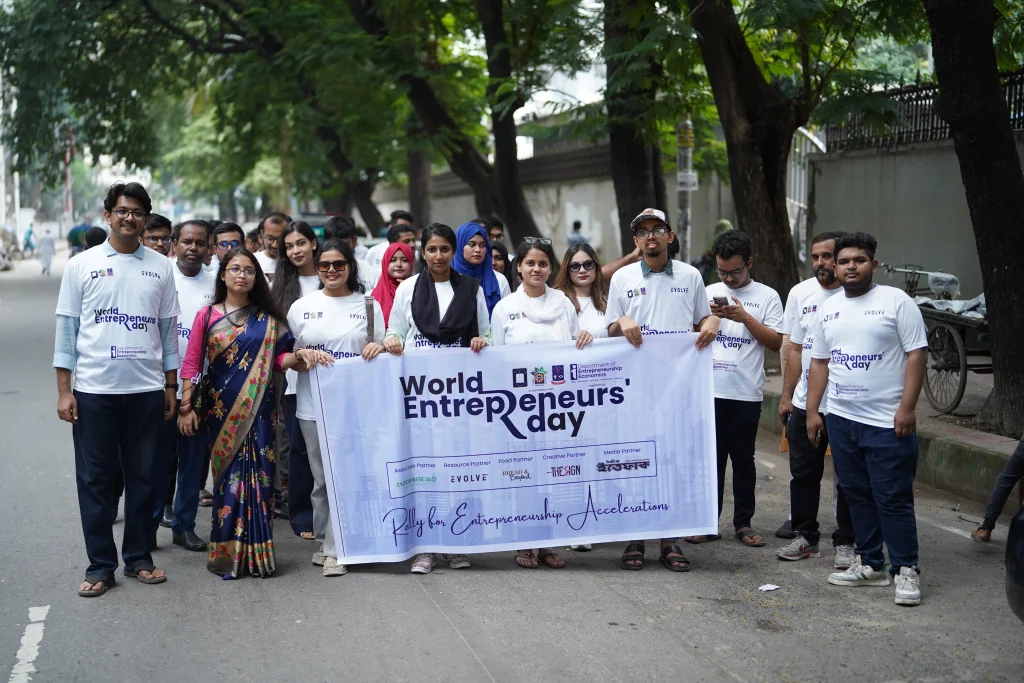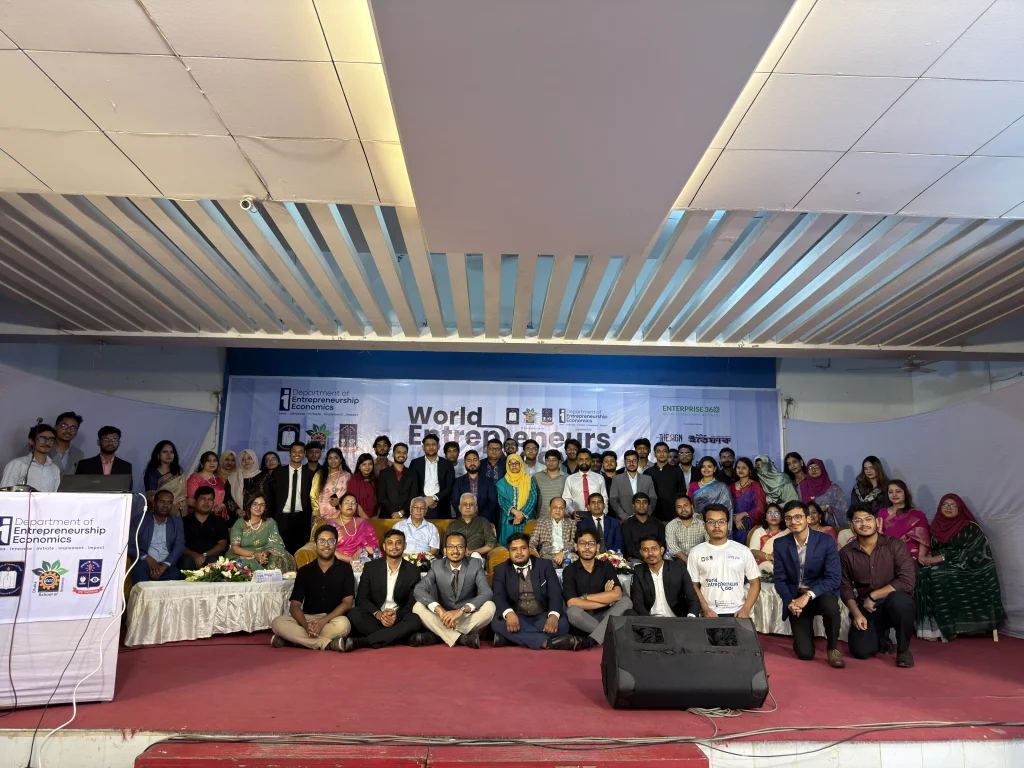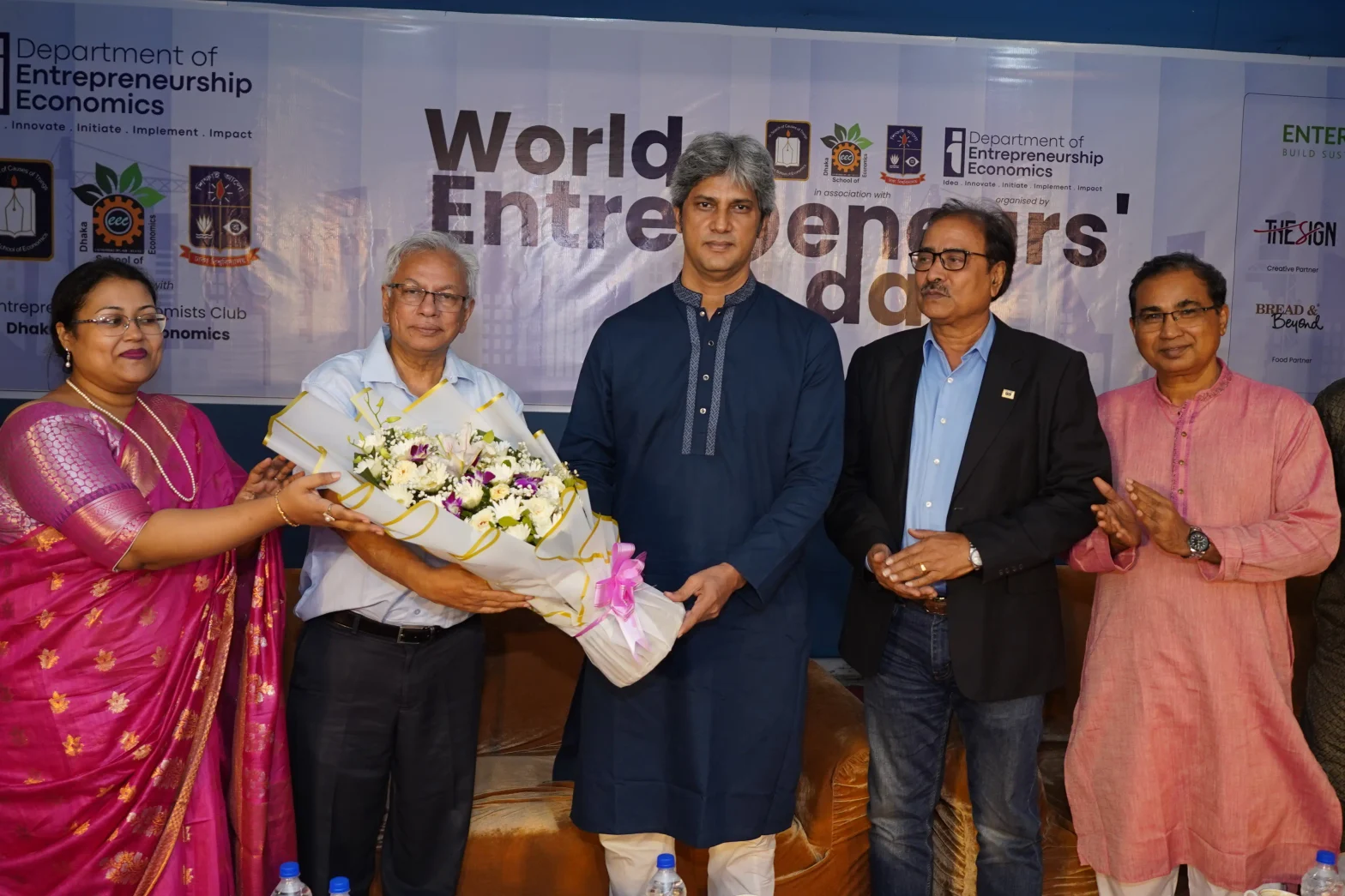
In a landmark initiative, the Department of Entrepreneurship Economics of the Dhaka School of Economics (DScE) celebrated World Entrepreneurs Day 2026 for the first time in Bangladesh, bringing together a distinguished gathering of policymakers, senior government officials, bankers, academicians, business leaders, entrepreneurs, media professionals, faculty members and students.
The day-long programme featured an inauguration and rally in the morning followed by a formal seminar in the afternoon at the SWID Convention Hall, Dhaka School of Economics. The celebration highlighted the growing importance of entrepreneurship in employment generation, innovation, economic diversification and the development of a dynamic national economy.
The formal session was graced by Mr. Md. Zonayed Abdur Rahim Saki, MP, Hon’ble State Minister, Ministry of Planning, Government of the People’s Republic of Bangladesh, as the Chief Guest. The session was chaired by Professor Dr. A. K. Enamul Haque, Hon’ble Chairman, Governing Body, Dhaka School of Economics and Director General, Bangladesh Institute of Development Studies (BIDS).
Among the distinguished special guests were Anwar Faruque, Director, Bangladesh Krishi Bank and former Agriculture Secretary, Ministry of Public Administration; Brig Gen Abul Kashem Md Fazlul Kader, ndc (rtd.); KSM Mostafizur Rahman, Managing Director, National Agricare Group; and Talat Mamun, Managing Director, Live TV. Ms. Rehana Parvin, Director, Dhaka School of Economics, also attended the programme and shared valuable insights on entrepreneurship and education.
Chief Guest, State Minister Md. Zonayed Abdur Rahim Saki emphasized that entrepreneurship must be placed at the centre of Bangladesh’s efforts to generate employment and build a more innovative economy.
He said the government is working to create an environment in which more people can become entrepreneurs, particularly young people with innovative ideas and the potential to build sustainable ventures. He also highlights the importance of establishing and strengthening funding mechanisms and financial support systems so that promising entrepreneurs can gain access to finance and move their ideas from concept to implementation.
The State Minister emphasized that entrepreneurial development requires more than motivation. Entrepreneurs need access to capital, markets, skills, technology, institutional assistance and an enabling policy environment.
Chairing the seminar, Professor Dr. A. K. Enamul Haque emphasized that entrepreneurship is particularly important for Bangladesh because of its role in reducing unemployment and creating alternative avenues of productive employment.
Professor Enamul Haque also urged society to look beyond conventional success narratives. He emphasized that failure stories should receive greater attention alongside success stories so that aspiring entrepreneurs can understand the actual realities of entrepreneurship. According to him, failure can provide valuable lessons about risk, decision-making, business strategy and resilience.
Speaking from his extensive experience in public administration, agriculture and banking, Anwar Faruque, Director, Bangladesh Krishi Bank and former Agriculture Secretary, highlighted the significant potential of agriculture-based entrepreneurship and rural enterprise development.
He emphasized the need to connect entrepreneurship with Bangladesh’s large agricultural and rural economy and pointed to opportunities in agro-processing, agricultural technology, value-chain development, storage, logistics and market-oriented agribusiness.
Brig Gen Abul Kashem Md Fazlul Kader, ndc (rtd.), Head of Service and Estate Division, IFIC Bank PLC, shared his perspective on the importance of professionalism, leadership, discipline and effective execution in entrepreneurship. Drawing on his extensive institutional and managerial experience, he emphasized that a successful entrepreneurial venture requires not only an innovative idea but also strong leadership, strategic planning, disciplined execution and the ability to respond effectively to uncertainty and change.
KSM Mostafizur Rahman, Managing Director, National Agricare Group, emphasized the enormous opportunities available in agriculture, agribusiness and related value-added sectors.
He highlighted the need for entrepreneurs to move beyond traditional agricultural activities and explore areas such as modern production systems, agro-processing, technology-based agriculture, distribution, supply chains and value-added products.
Talat Mamun, Managing Director, Live TV, highlighted the importance of communication, media visibility and storytelling in strengthening the entrepreneurial ecosystem.
He emphasized that entrepreneurs need not only innovative products and viable business models but also the ability to communicate their ideas effectively to customers, investors and the wider public.
MS. Rehana Parvin, Director, Dhaka School of Economics, shared valuable insights on the role of educational institutions in building entrepreneurial capacity.
She argued that entrepreneurship education should go beyond theoretical classroom instruction and should provide students with opportunities to develop practical skills, identify opportunities, solve problems, build networks and engage directly with entrepreneurs and industry.
She also emphasized the importance of creating stronger connections between academic institutions and the wider entrepreneurial ecosystem so that students can move more effectively from learning to experimentation and from experimentation to enterprise creation.
Entrepreneurs from the department showcase businesses and ideas
A special feature of the programme was the participation of entrepreneurs emerging from the Department of Entrepreneurship Economics. They shared their entrepreneurial journeys, discussed the challenges they had faced and presented their businesses and innovative ideas to the audience.
Their participation demonstrated the practical impact of entrepreneurship-focused education and provided students with real-world examples of how ideas can be transformed into business ventures.
The stories also reinforced an important message from the seminar: entrepreneurship is a journey involving experimentation, uncertainty, setbacks and continuous learning—not simply a story of immediate success.
Speaking on “Entrepreneurship Ecosystem,” Shamim Ahmad, Faculty Member, Department of Entrepreneurship Economics, highlighted the contribution of the department and its alumni to the development of Bangladesh’s entrepreneurial landscape.
He emphasized that the growing contribution of the department’s alumni, many of whom are increasingly becoming entrepreneurs, business professionals and ecosystem contributors.
The programme concluded with a vote of thanks by Forhadul Islam Bhuiyan, President, Entrepreneurial Economists Club, Dhaka School of Economics. He expressed gratitude to the Chief Guest, Session Chair, special guests, academicians, bankers, entrepreneurs, industry professionals, faculty members and students for their participation and valuable contributions.
He highlighted the importance of continuing such initiatives to strengthen entrepreneurship awareness, develop entrepreneurial talent and build stronger connections among the different stakeholders of Bangladesh’s entrepreneurial ecosystem.
The first-ever celebration of World Entrepreneurs Day in Bangladesh by the Department of Entrepreneurship Economics of the Dhaka School of Economics marked a significant milestone in the country’s entrepreneurship discourse.
The event brought together government, finance, academia, business, media and entrepreneurship in one forum and highlighted a shared understanding that Bangladesh’s future entrepreneurial growth will depend on more than individual initiative.
It will require access to finance, skills development, innovation, market opportunities, institutional support, responsible leadership and an ecosystem that allows entrepreneurs to learn from both success and failure.
The celebration therefore served not merely as an observance of World Entrepreneurs Day, but as a broader call to build a more connected, inclusive and opportunity-driven entrepreneurial ecosystem for Bangladesh.